

Craterian Theater
History
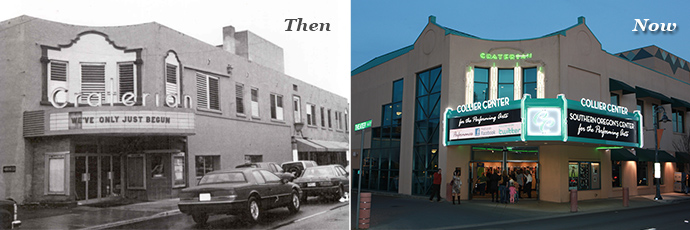
The Craterian Story
The Craterian Theater at The Collier Center is a state-of-the-art performance venue and gathering place for the community of Southern Oregon. The facility features excellent acoustics and sightlines, an impressive array of theatrical equipment, and is operated by a professional staff. The auditorium is intimate and comfortable and can seat up to 750 patrons, and the stage can accommodate large music, dance and theatrical tours, as well as local productions.
The Craterian Theater is a vibrant facility utilized by all parts of the community for performances, rehearsals, classes and workshops, conferences, receptions, parties, seminars, trainings, etc.
Laughter and tears, mystery, romance and high drama…the sounds and sights of music, dance, vaudeville and old silent films! Applause, a great deal of applause, resounds in the walls and memory of this historic theater.
But first it was bricks and mortar, a business building designed in Spanish Colonial style by architect Frank C. Clark. Erected on this site in 1924 by J.C. Cooley and P.J. Neff, it housed law offices, shops and a theater leased by George A. Hunt.
A skilled promoter, Hunt staged a naming contest with a $25 prize. From 1500 entries, he chose “Craterian” for nearby Crater Lake, a creative variation of that era’s familiar moviehouse name, Criterion.
The grand opening was October 20, 1924. A sell-out audience of nearly 1200 came to see a play, “The Havoc” and hear music from a grand Wurlitzer organ played by Grace “Betty” Brown. Later, movie projectors were installed for silent film. Vaudeville and theatrical acts were booked, including a very young dancer named Ginger Rogers.


Social Connections
The next few years brought talking pictures (like Al Jolson in the “Jazz Singer,” 1928), the comfort of air conditioning and…the Great Depression. Hunt sold his lease to the Fox chain, then returned in 1933 after their bankruptcy. To bolster the box office, he remodeled the theater, lowered matinee prices to 15¢, showed first-run films (such as the “Thin Man” series with William Powell and Myrna Loy), staged WWII bond drives and numerous community events.
After several other owner/operator changes, more building alterations and sale of the old Wurlitzer, audience diminished. In the late ’70s, multi-screen theaters and home television had taken their toll on movie houses like the Craterian.
By the end of 1985, the historically-registered old building had been given to the neighboring Rogue Valley Art Association with the hope it might “…foster community theater activities.” After several years, the Craterian Performances Company (CPC), a nonprofit volunteer group, was formed. Its vision: to create a performing arts center, rich with history but modern in facilities for public multi-purpose use, in the heart of downtown Medford.
Response was enthusiastic: $5.2 million was pledged by more than 600 individuals, businesses and foundations as well as the state, county, city and the urban renewal agency. Renovation and construction with innovative use of large portions of the original structure, began in 1996. A March 1997 opening date was set…and met!